Report of Stapo Tilsit - July 1, 1941
Copy 1
Registered
To: The Main Office of Reich Security - IV A 1 [2]__________________________
Regarding: Mopping-up [8] operations across the former Soviet-Lithuanian borderIn Polangen on the day after occupation, one officer was also treacherously shot by the population.
At all three large deployments predominantly Jews were liquidated. Included, however, were Bolshevik officials and snipers, some of whom as such, had been handed over to the security police by the armed forces [Wehrmacht]. [13]
On the day after the operation on 25. June 1941, Krottingen was presumably burned down by the remainder of the Jewish population there. More precise details were not to be ascertained. So far, a renewed operation was avoided, since only Jewish women and children remained in Krottingen, [and as they were] located in the vicinity of Krottingen [they were] at the time still in the custody of the Lithuanian authorities. [14] A new troop division reporting for duty took over surveillance of Krottingen on June 27, 1941.
One police officer and 30 men were assigned for the shootings by the Director of Police in Memel.[15]
The collaboration with the German armed forces was {Page 3} coordinated by the town commanding officers who voluntarily assisted with the planned operations. The implementation of the operation was discussed on June 24 with SS-Brigadeführer Stahlecker who as a matter of principle declared his agreement with the mopping-up operations near the German border. [16] On 25. June, 1941, contact was established with the commander of the special forces I A in Memel, SS- Sturmbannführer Sandberger with whom it was agreed that all necessary future operations would be carried out in their present form in an area of 25 km along the former Soviet border.
The former chief of the Lithuanian state security police, Pranas Jackys,[17] born on 30. July 1900 in Lydavenen, who worked as agent for the Tilsit section of the security forces, was appointed to maintain peace and order in Krottingen. The necessary support will be given to him by the border police authority in Memel.
In Polangen, contact was established with the current newly appointed Mayor, who maintains the necessary connection with the security police regarding affairs of the branch office of the Tilsit section of the security forces in Memel.
The Soviet-Russian espionage agent, Boleslawas U s z p a l i e s, born on 24. Jan. 1892 in Platellai, recently residing in Kretinga, was transported to Tilsit for the purpose of a detailed interrogation regarding his connections in Germany.
The fugitive Jewish official, Libe Chaye Benjaminaviciute, born, 1920 (photo available) is considered to be the presumed culprit in the treacherous shooting of an officer in Polangen.
Other punishment operations took place through officials of the border police authority Suwalki in Augustowo. A children’s convalescent home was also seized there among others. The SS- Reichsführer [18] and the Gruppenführer [19], who were there by chance, were informed about the measures {Page 4} taken by the Tilsit State police authority [20] and fully approved of them. The Gruppenführer ordered that the seized building should absolutely be held for the SS-Reichsführer until further notice. Surveillance is guaranteed by the forces of the border police authority Suwalki.
________________________________________________________________________
Notes (by John S. Jaffer):
[1] Note concerning the building at SA Street 67


Enlargement (bottom photo is enhanced with unsharp mask function of freeware graphics program)
A city map of Tilsit available here (click on red words Karte anzeigen) (site at bildarchiv-ostpreussen.de) shows this building between Fabrikstrasse and the Schlossmühlenteich. Der Grosse Brockhaus (15th ed. 1934) identifies the building as Polizeidirektion (police headuarters), and states the structure was built in 1929-30.
1939 streetmap of Tilsit showing SA-Strasse (B.V.-Karte) at the previous location of Fabrikstrasse is posted at www.landkartenarchiv.de.
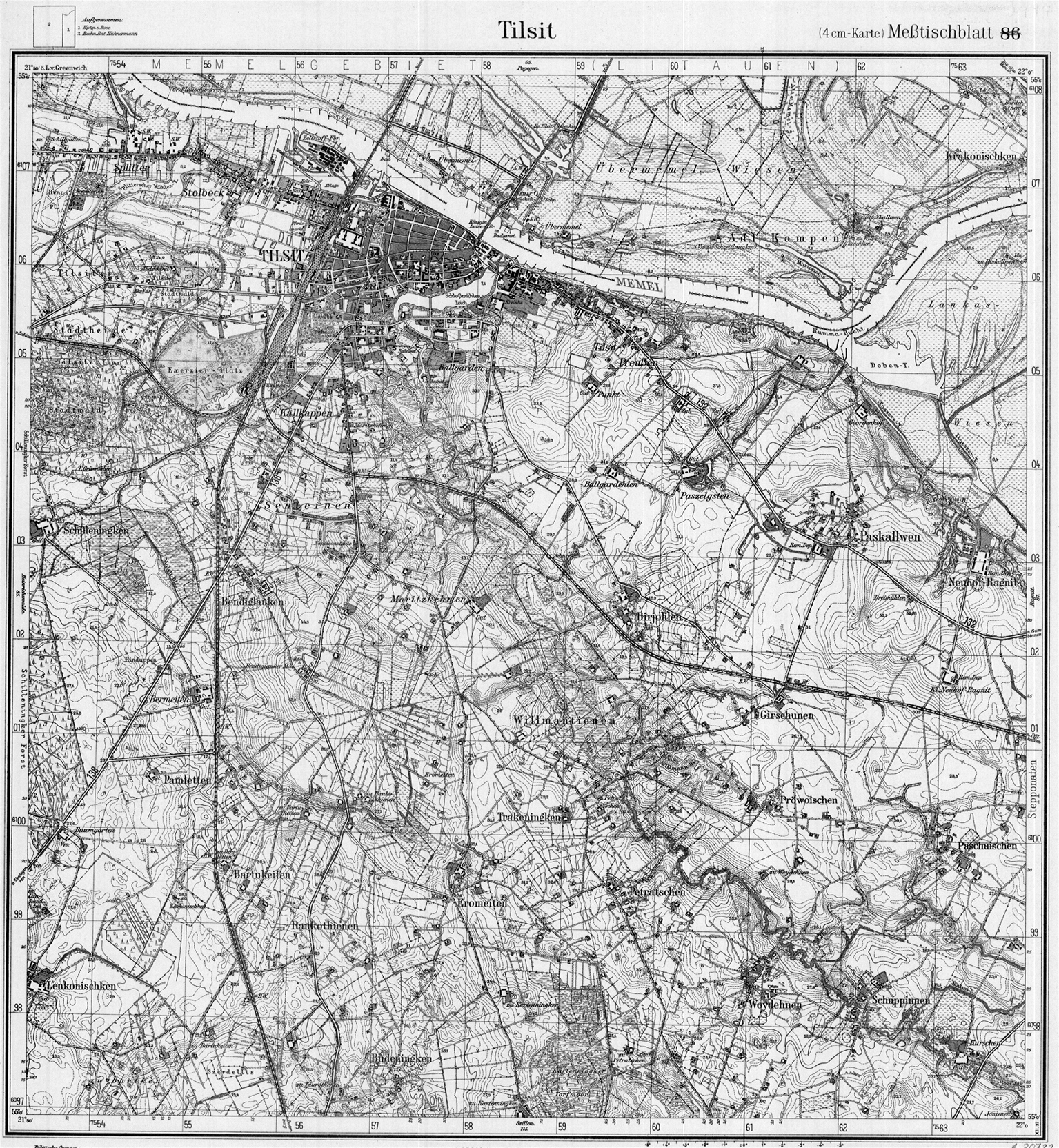
1:25,000 map of Tilsit (1927) at the Digital Library, University of Greifswald. Shows Schlossmühlen - Teich. Map is too early to show this building.
Tilsit is now Sovetsk, Russia. For a recent aerial photo on Wikimapia of
this location, click here.
The building is identified as Sovetsk Film Technical School. For photo of
building on Panoramio, click here.
A photograph of Fabrikstrasse in 1918 is shown at www.castlesofpoland.com
[2] Section IV of the Reich Security Main Office (RSHA) was the Gestapo. Section IV A 1 was the subsection of the Gestapo dealing with Communism. Raul Hilberg, The Destruction of the European Jews, New York: Harper & Row (1979), p. 184.
[3] Brigadeführer was the SS-Rank equivalent to Brigadier General. Müller was head of the Gestapo. Hilberg, p. 188, 766.
[4] "Brif." - Brigadeführer. Stahlecker was the head of Einsatzgruppe A, the Mobile Killing Squad which followed the German Army into Lithuania. Hilberg, p. 188.
[5] Rasch was the head of Einsatzgruppe C, the Mobile Killing Squad which operated in the Ukraine. Hilberg, p. 188, 712. "Pr." - Prussia.
[6] "E.K. Ia" - Einsatzkommando 1a. The Einsatzgruppen were divided into smaller units called Einsatzkommandos and Sonderkommandos. Most sources use the term "Sonderkommando 1a" (SK 1a) for this subunit of Einsatzgruppe A. See, e.g., Hilberg, p. 188. It is also stated in organization lists that SK 1a, headed by Sandberger, became operative in 1941, while EK 1a (also headed by Sandberger) operated in 1942. However, this group operating in summer of 1941 was called "EK 1a" in Operational Situation Report 12 and Operational Situation Report 24 (at jewishvirtuallibrary.org)
[7] Sturmbannführer was the SS-Rank equivalent to
Major. Sandberger was head of Sonderkommando 1a. Hilberg, p. 188, 766.
"GPK" = Grenzpolizeikommisariat (Border Police Office). (KZ -
Verbrechen vor deutschen Gerichten, vol.2, p.79.)
[9] These preliminary orders have never been located. Konrad Kwiet, "Rehearsing for Murder: The Beginning of the Final Solution in Lithuania in June, 1941," Holocaust and Genocide Studies 12 (1998) at n. 10. Complete article by Prof. Kwiet is posted at defendinghistory.com. This section of the Report states that orders came from Section IV A 1. Kwiet indicates that these orders, which resulted in the organization of Einsatzkommando Tilsit, were issued by Müller, head of the Gestapo. Bert Hoppe and Hildrun Glass, in Sowjetunion mit annektierten Gebieten I: Besetzte sowjetische Gebiete unter deutscher Militärverwaltung, Baltikum und Transnistrium (Munich 2011), pp. 143-144, also state these orders have not been found.
The word "Vorgang," translated here as "precedents," also means "proceeding, occurrence, incident, event, transaction, precedence, priority, example, model." Heath's German Dictionary (1906).
[11] A reader has suggested that "dort." is an abbreviation for "dortiges," and that a rough translation would be "therein located." Each of the entries refers to a numbered telex which contains a numbered decree.
[12] Blitz (lightning) Fernschreiben
- express telex
[13] This sentence, and the sentence before Note 15,
bear on the degree of cooperation between the armed forces and the
Einsatzkommandos.
[14] This is a critical sentence to those who contend that as of this time period there were no orders to kill women and children, and that the decision to do so was made several months later.
[15] Bernhard Fischer-Schweder, who was a defendant in the Ulm trial.
The Ulm judgment, accepting the testimony of Böhme and Hersmann on this
point, concluded that Stahlecker arrived in Tilsit at around 8 PM on June
22, and gave Böhme a verbal order for the Gargzdai killings that evening
or night. Böhme requested Stahlecker to obtain written confirmation from
Stahlecker's superiors, which arrived by telex the morning of June 23.
This contemporaneous Report of July 1 (unknown at the time of trial)
dates the meeting between Stahlecker and Böhme on June 24, not June
22. Professor Kwiet indicates that this meeting took place during the
evening of June 24, after the Gargzdai killings had already taken place,
and that this statement in the Report casts doubt on the claim, asserted
by the defendants in the Ulm trials, that Stahlecker had ordered the
killings in advance. Kwiet, supra,
at notes 31 and 8 - 10. Patrick Tobin, in No
Country
for
Old
Fighters:
Postwar
Germany
and
the
Origins of the Ulm Einsatzkommano
Trial, Masters Thesis, University of North Carolina - Chapel Hill,
2009, at p. 72, indicates that if this later discovered document had been
available to the Ulm prosecutors, it would have provided evidence of
murder against Böhme and Hersmann, beyond the crime of accessory to murder
for which they were convicted.
Dictionary definitions of the word "grundsätzlich" used in this sentence include "as a matter of principle," "on principle," "based on principle," and "fundamental." Duden Stilwörterbuch der deutschen Sprache (1970) lists an alternate meaning of "im allgemeinen, meist, eigentlich" (generally, mostly, really). Thus the German sentence in isolation might be ambiguous as to whether Stahlecker's agreement was absolute and without exception.
If this meeting took place after the shootings, the information which
Stapo Tilsit provided to Stahlecker may have found its way into Operational Situation Report 12 on July 4
. Report 12 stated to Berlin that Stapo Tilsit had "so far" shot 200
persons. This figure of 200 apparently referred only to the Gargzdai
killings, and omitted the Kretinga and Palanga shootings. These latter two
had taken place on June 25 and 27, but were not yet known to the author of
Report 12. On July 6, the Gargzdai, Kretinga and Palanga killings were
reported by Einsatzgruppe A to Berlin in Operational Situation Report 14.
The location of Stahlecker during this time period was confirmed by interrogation of his adjutants Finnberg and Eichler. Christoph Dieckmann, The First Two Weeks of German Rule in Lithuania - June/July 1941, in E. Barkan, E. Cole, and K. Streve, Eds., Shared History, Divided Memory: Jews and Others in Soviet Occupied Poland (2007), at 358 n. 10. He was in Königsberg on June 23, in Tilsit on June 24 when he met with Böhme, and Kaunas on June 25.
Bert Hoppe and Hildrun Glass, in Sowjetunion mit annektierten Gebieten I: Besetzte sowjetische Gebiete unter deutscher Militärverwaltung, Baltikum und Transnistrium (Munich 2011), pp. 143-144 n.7, indicate that since the time of the meeting is not set forth in the Report, it cannot be said whether Stahlecker approved the Gargzdai killings after the fact or ordered them in advance.
[17] Pranas Lukys alias Jakys was a defendant in the
Ulm trials. See Nazi Crimes on Trial - University of Amsterdam, Case No. 499.
For detailed information about Lukys, see Helmut Langerbein, Hitler's
Death Squads: The Logic of Mass Murder (Texas A&M University
Press, 2003). ISBN 1585442852, 9781585442850
[19] Heydrich. Kwiet, supra, at notes 38 - 39. Gruppenführer was the SS - Rank equivalent to Major General. Hilberg, p. 766.
[20] Jürgen Matthaus, in "Controlled
Escalation:
Himmler's Men in the Summer of 1941 and the Holocaust in the Occupied
Soviet Territories," Holocaust and Genocide Studies 21, No. 2 (Fall
2007) 218, 223 translates this sentence as including "the measures
initiated by the Stapostelle Tilsit." Matthaus emphasizes the phrase
to state that the initiative came from below.
[21] gezeichnet - signed or drawn. Indicates original document had handwritten signature.
Although the signor is not identified in this copy, sources agree that this document was authored by Hans-Joachim Böhme.
Biography of Böhme at Wikipedia (German) and (English) and photograph at Yad Vashem.[22] Wt. - probably the typist's initials. The practice was to capitalize the initial of the last name and to place it first.
 |
|
 |
|
 |
|
 |
|
|
| This document from the former Soviet Archives is discussed in
such sources as Konrad Kwiet, "Rehearsing
for
Murder: The Beginning of the Final Solution in Lithuania in
June, 1941," Holocaust and Genocide Studies 12
(1998), Jürgen Matthäus, Assault and Destruction, in W. Reich, Hidden
History
of the Kovno Ghetto, United States Holocaust Memorial
Museum, p. 18 (1997), Patrick Tobin, No
Country
for
Old
Fighters:
Postwar
Germany
and
the
Origins of the Ulm Einsatzkommano
Trial, Masters Thesis, University of North Carolina - Chapel
Hill, 2009, and Bert Hoppe and Hildrun Glass, Sowjetunion
mit
annektierten Gebieten I: Besetzte sowjetische Gebiete unter
deutscher Militärverwaltung Baltikum und Transnistrium, (Munich
2011),
pp. 143-144.
|