also known as: Várkulcsa (HU), Klučsárka (CZ), Klyucharki (RU), Klicherkes (Yiddish)
48°25' N / 22°39' E
~ Introduction ~
( Click the arrow in the buttons below for pronunciation. )
Klyucharki
was part of the Kingdom of Hungary (11th century - 1920 and 1938-1944) with the name of Várkulcsa
in the Bereg megye (county), next part of Czechoslovakia (1920-1938) with the name Klučsárka
in Podkarpatská Rus (Sub-Carpathia), then part of the Ukrainian Soviet Socialist Republic (1945-1991) with the name of Klyucharki and, since 1991, known as Klyucharki in the Mukachevskiy (Mukachivs'kyy) rayon (district) and the Zakarpats'ka oblast (county) of Ukraine.
Other spellings/names for Klyucharki are Kluĉárky, Kljucsarki, Klyucharky and Pavsino. In Yiddish, Klyucharki was referred to as Klicherkes
.
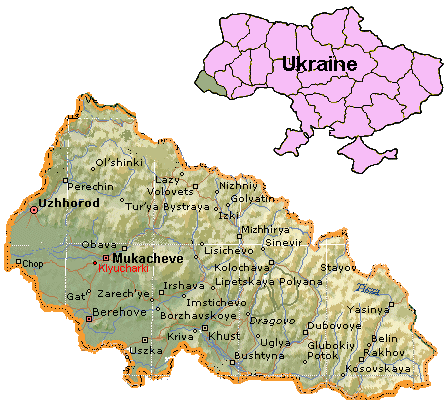
Klyucharki is located about four miles southwest of Mukacheve.
The first Jews probably settled in Klyucharki early in the 19th century. The population of Klyucharki in 1877 was 592 made up of Hungarians, Rusyns and Jews and comprised the following religions: Roman Catholic (76); Greek Orthodox (461); Reformed (1) and Jewish (54). In 1877, the Jews of Klyucharki attended the Uj-Dávidháza synagogue.
With the Hungarian occupation of Klyucharki, in March 1939, Jews were persecuted and barred from their occupations. In 1941, Jews from Klyucharki were drafted into forced labor battalions and others were drafted for service on the Eastern front, where most died.
In August 1941, a number of Jewish families without Hungarian citizenship were expelled to Nazi-occupied Ukrainian territory, to Kamenets-Podolski, and murdered there.
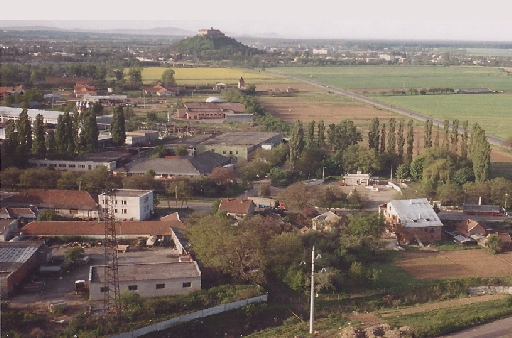
In 1944, Klyucharki was still a small village of only a couple streets, bordering the main road from Mukacheve to Chop (Csap), the present-day border crossing point to Hungary. By this time, the village was home mainly to Hungarians, Germans (Schwabs), some Czech and Jewish families numbering approximately 120 people that attended a small synagogue with a mikvah bordering the main road.
The remaining Jews of Klyucharki were deported to Auschwitz in mid-May 1944.
Klyucharki was liberated by the Soviet Army on 26 October 1944.
Most of the Jews from Klyucharki were murdered in Auschwitz; a few survivors returned, but eventually settled elsewhere. Those who were seen returning to Klyucharki were members of the following families: FECHTEL, FUCHS, HALPERT, KATZ and ZIEGLER.
Today, Klyucharki is a rather large village of about 2,500 inhabitants including Hungarians, Ukrainians, Russians or Ruthenians. Most of the Germans (Schwabs) and Czechs have gone back to their countries. No Jews live there today.
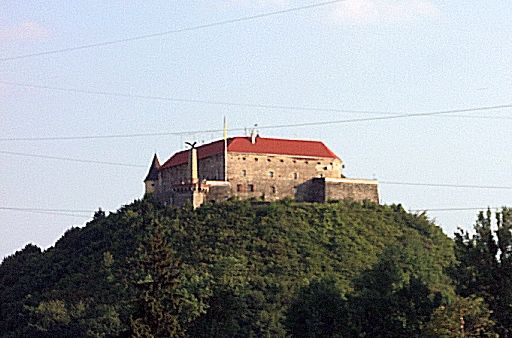
Palanok Castle is located on a volcanic hill overlooking the city of Mukachevo and surrounding villages. It was originally constructed during the 14th century and its structure has undergone major modifications throughout the ages. Briefly, the founding cornerstone for Palanok Castle was laid sometime in the 14th century. Through the centuries, the castle served as a residence to many people. In 1396, the Ruthenian Prince Fyodor Koriatovych purchased the city of Mukachevo, and settled in the castle. It remained in his family for almost 200 years. The extremely revered Hungarian patriot, Prince Ferenc Rakoczi, lived there and began his anti-Hapsburg uprising from the castle. His mother, Ilonya Zrini livved in the castle and it was a residence of the Koriatovych family for almost 200 years. The castle was given by the Hapsburgs to the Schönborn family, who were responsible for an expansion of the town and brought German settlers to the region. It, then, was used as a prison and agricultural college; today, it is a museum. The castle was surrounded by a deep ditch that contained a high wooden fence called "Palanok;" hence, it's name. There is a room in the castle set aside for Jewish history from the Mukacheve region and to commemorate those Jews who were murdered in Auschwitz.
This page is hosted at no cost to the public by JewishGen, Inc., a non-profit
corporation. If you feel there is a benefit to you in accessing this site,
your JewishGen-erosity is appreciated.

 below for pronunciation. )


)