Svencionys
(Shventenai,
Schvenchionys, Shvencionys, Shvenchenis, Shventshenis)
Svintsyan, Svintsian,
Sventsian, Svenchan
Shvintzion, Svintzian,
Sventzion
Sventsiany, Swenziany,
Shvyentsiani, Shvyetsiani
Swieciany,
Swienciany, Svieciany, Swenciany, Svenciany
~ For my great grandfather, Leib
Khonon Kovarsky ~
b. Sventsiany 1839 - d. Sventsiany
1892
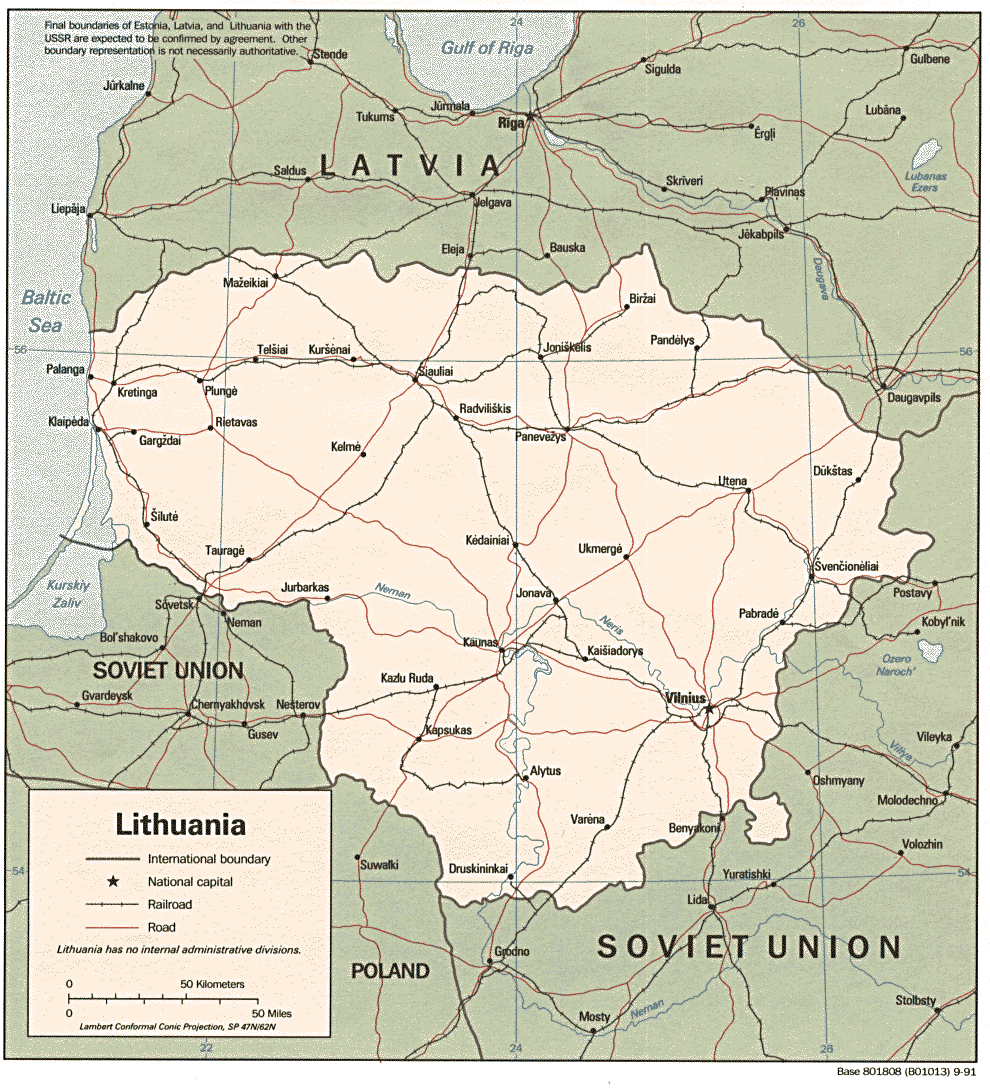
Location of Svencionys

- Eastern
Lithuania, in the Svencioniu Rajonas
(literally, "Rural District"--an
Administrative Region),
bordering Belarus
-
55 09'/26 10'
Svencionys is located on the banks of the Kuna Stream 46.6
miles NE of Vilnius, the capital of the Republic of Lithuania
(Lietuvos Respublika). It sits at an altitude of 593
feet in a region with many forests and almost 300 lakes.
Written sources from the
15th century date the founding of the town to the 13th
century. The name appears to derive from the Lithuanian
ventas, meaning holy, blessed, sacred, sainted,
hallowed, or perhaps also from the Lithuanian vente,
meaning holiday, gala, feast, festival. The modern name of the town of Svencionys is
pronounced as if its English spelling were "Shven-TSHYO-nis,"
with the accent falling on the next-to-last
syllable.
Svencionys
Municipal Web Site
A Somewhat
Deeper Look at Svencionys History
Lonely
Planet Map of Lithuania
Google
Map Showing Svencionys
Map
Showing Roads and Railroads (Svencionys is 6.7
miles east of Svencioneliai, shown on this map; click on map to
enlarge.)
Throughout its history, the town now known as Svencionys,
Lithuania, has had many different names with numerous
spellings. Among former residents and Holocaust survivors,
the shtetl is usually referred to by its Yiddish name, which,
transliterated, is commonly spelled "Svintsyan" or "Sventsian"
(pronounced "Svints-YAHN," with the accent on the final
syllable.) At this site, wherever a general name is
required, "Svintsyan" will be used.
The history of Svintsyan is linked to the tangled history of
Lithuania, which has sometimes been an independent nation and
sometimes not and was broken up between the two World Wars,
with regions containing Svintsyan moving between several
different countries.
Political History of Lithuania
and Svintsyan with Regard to Location
Pre-19th
Century
The Jewish
presence in Lithuania dates back to the early part of the 14th
century. Lithuania was an important center for artisans
and craftsmen in the Middle Ages, and the Jews took part also in
these occupations. By the 17th century, Lithuanian
yeshivot had become famous all over the world. Many
Lithuanian Jews worked as craftsmen or leased businesses,
sometimes also administering estates belonging to others.
And they were moneylenders and tax collectors. Though Jews
in the Polish-Lithuanian Commonwealth were limited as to what
they could own, they were given legal equality with
non-Jews. Perhaps for this reason, the number of Jewish
inhabitants of Lithuania increased steadily during the 16th
through the 18th centuries.
History
of the Jews in Lithuania
The period
preceding the 19th century gave birth to several important
Jewish religious movements that were to have varying degrees of
influence in Lithuania and in Svintsyan. These were
Shabbeteanism, Frankism, Hasidism, the Haskalah, and the
Orthodoxy advocated by the Vilna Gaon.
Pre-19th-Century Jewish
Religious Movements
What is a
Litvak?
Litvaks from the Lithuanian Cultural
Heritage Site
19th Century
Lithuanian Jews
under Russia
The
partitions of Poland ending in 1795 had made Lithuania part of
the Russian Empire. For most of the next 200 years,
Lithuania remained under Russian domination. Catherine the
Great, ruler of Russia at the time of the partitions, had
established a pale that restricted Jews, with few exceptions, to
certain prescribed areas within the Russian Empire, prohibiting
them from settling elsewhere. Various legal restrictions
continued to apply to Jews in the Pale of Settlement.
Napoleon and Svintsyan
The
invasion of Russia by Napoleon in the early part of the 19th
century was an event that could have changed the status of the
Jews. Napoleon had shown himself to be a great friend of
the Jews in Italy, where he had abolished the ghettos. He
had promoted the idea of a Jewish homeland in Palestine and had
given the Jews civil liberties and religious equality in France.
Napoleon
and the Jews
But he
was, of course, coming to Russia as a conqueror. Russian
Jews were suspicious of Napoleon's reforms; and the Hasidic
rabbis were afraid that, in turning toward Napoleon, the Jews
might turn away from God. In Lithuanian territory in
the summer of 1812, Napoleon had not reckoned on the heat and
rain that transformed the roads into mud, impeding the
progress of supply wagons. His inadequately provisioned
soldiers rioted and looted in Vilna--a fact that undoubtedly
also prejudiced the local population against him.
Proceeding to Svintsyan, Napoleon stopped there for one night at
the largest house in town and, in the morning, reviewed his
guard and troops from the balcony. This house, known
afterwards as "Napoleon's House," would eventually belong
to a Jewish woman, Margolia Pliner, who, prior to the Holocaust,
ran it as a mini-hotel with a first-floor refreshment bar and
bakery.
The Jews and the Russian
Army
Various
forms of repression for the Jews had begun in Russia before
Napoleon and continued after his campaign there failed.
Many of these had conversion of the Jews to Christianity as
their aim. A particularly heinous 1827 statute of Tsar
Nicolas I required a quota of army conscripts from each Jewish
community. Unlike other Russians, who were required to
serve in the army for 25 years, Jewish boys had six years added
to their term of service prior to age 18, which meant that
12-year-olds and sometimes boys even younger were often forcibly
removed from their families and obliged to serve in the military
Jews in
the 19th-century Russian Army
Jewish Religious Movements
In the
19th century, the Haskalah, or Jewish "Enlightenment," which had
long been active elsewhere, finally reached Lithuania and began
to gain many adherents there. Another religious movement,
the Musar (or "Mussar") Movement, with some elements of both the
Haskalah and Hasidism, also attained prominence at this time but
eventually died out in Lithuania.
19th-Century Jewish
Religious Movements
The great
appeal to Russian Jews of the Haskalah had been that it stressed
secularism and assimilation and thus was envisioned as a movement
which could put an end to antisemitism. But in this
particular aim it would fail in 19th-century Lithuania and the
rest of the Russian Empire because of a dramatic event in St.
Petersburg.
Assassination and Its
Aftermath
On
March 1, 1881, Tsar Alexander II, a popular monarch who had
freed the serfs, was assassinated. Although of the six
conspirators subsequently rounded up, only one was Jewish (a
young woman named Gessia Gelfman), pogroms broke out in many
southwestern areas of the Pale of Settlement, prompting a wave
of Jewish emigration that would eventually spread to other parts
of the Pale and continue for many years. The Jews of
Lithuania were initially spared because the Governor of Vilna
Province prohibited pogroms. But fires set by arsonists ravaged
many Jewish neighborhoods throughout Lithuania.
Although
the next Tsar, Alexander III, promulgated some reforms favorable
to the Jews, this attitude was short lived. In 1804, Jews
had been ousted from villages and ordered to settle in rural
areas--a plan which soon, however, proved largely
unworkable. The 1882 "May Laws" reduced the area of the
Pale and confined Jews to towns, prohibiting them from settling
in rural areas. Jews could not own land or property except
for the houses they already lived in, and they were barred from
many professions. The numerus clausus of 1887
established quotas of only 10% for Jewish students in Russian
schools and institutions of higher learning within the Pale of
Settlement, and there were even more restrictive quotas for Jews
living in Moscow and St. Petersburg.
The
expulsion of the Jews from Moscow in 1891 brought refugees
pouring into the northwestern part of the Pale and gave impetus
to a subsequent flood of Jewish emigration from Lithuania.
The emigrees from Lithuania went primarily to America; and they
went, in somewhat smaller numbers, to South Africa.
Zionism and the
Jews of Svintsyan

Interest in
establishing Jewish settlements in Palestine was also
sparked. In 1897, Theodor Herzl convened the First
Zionist Congress in Basel, Switzerland, writing in a prophetic
September 3, 1897 diary entry, "In Basel, I founded the Jewish
State."
Theodor
Herzl
Some of
Svintsyan's Jews raised funds or traveled to the Holy Land with
the Vilna "Lovers of Zion" to purchase tracts and plant
vineyards. A few "Svintsyaners" went to Palestine to live
in the latter part of the 19th century; more would immigrate and
settle there in the 20th. These aliyahs would save many
Lithuanian Jews, including the immigrants from Svintsyan, from
annihilation in the Holocaust.
Religion in
Svintsyan
Though
followers of the false messiah, Shabbetai Zvi, could still be
found in Lithuania for many years, in shtetls like Svintsyan one
of the most insulting things one could accuse a fellow Jew of
was Shabbeteanism.
By the
19th century, much of Jewish life in Svintsyan (as in other
Lithuanian towns) revolved around the shtetl's Orthodox
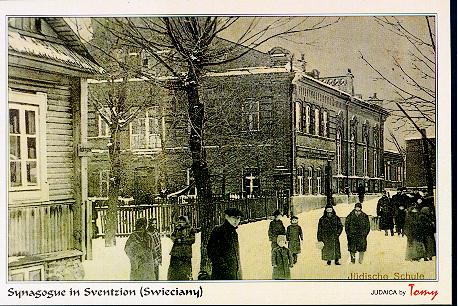
synagogues. One such synagogue, now referred to by
survivors as the "Old Synagogue," was a substantial brick
structure that could house a large congregation. It
eventually became home also to a family of storks, who
built a nest on its roof and returned there every year.
Photo of Svintsyan's "Old
Synagogue"
In
addition to the "Old Synagogue," for adherents of the Orthodoxy
propounded by the Vilna Gaon (mitnagdim), Svintsyan had
two Hasidic congregations and a synagogue for craftsmen and
artisans. It would eventually have a fifth synagogue,
referred to as the "New Synagogue"--also for mitnagdim.
The 19th
century saw the establishment of some of Lithuania's most famous
yeshivot, those of Volozhin, Slobodka, Mir, Radin, and
Telz. The yeshivot at Lida and Ponevez would be
established early in the 20th century.
Lithuanian
Yeshivot
Svintsyan had a yeshiva for awhile, too, under Rabbi Isaac Jacob
Reines.
Rabbi Isaac Jacob Reines
Isaac
Jacob Reines (1839-1915), who became Svintsyan's religious
leader in 1869, was an important proponent of the Haskalah in
Svintsyan. Reines established a yeshiva there in which
non-religious subjects as well as religious ones were taught and
physical labor was encouraged. His devotion to the study
of Russian secular subjects brought him into conflict with
Svintsyan's ultra-Orthodox population, particularly the Hasidim,
and Reines was obliged to close his school and leave for Lida in
1888. Reines eventually became a staunch admirer of
Theodore Herzl, joining the Zionist movement in 1898, and
publishing the book Or Hadash Al Tzion (A New Light on
Zion) in 1902. Although at the 6th Zionist Congress
in 1903 the practical Reines supported the British proposal for
a Jewish homeland in Uganda, Reines is best known today as the
founder of the Mizrachi movement, which envisioned the return to
Palestine and establishment of a Jewish homeland there as the
solution to the problem of Jewish persecution.
Rabbi
Isaac Jacob Reines
Mordecai Menahem Kaplan
One of
the most famous "sons of Svintsyan" was Mordecai Menahem Kaplan
(1881-1983), born in Svintsyan to Israel Kaplan and Anna
Kowarsky, a member of a large family prominent in Svintsyan for
many years. (One of Anna's brother was Jonas Kowarsky,
born 1866, died 1933.) At the age of 9, Mordecai Kaplan
immigrated to America with his parents. In spite of the
Orthodoxy of his mother and father, Kaplan was attracted to
heterodox philosophies. Eventually he attended Jewish
Theological Seminary, becoming an ordained rabbi in 1902.
Kaplan rejected a literal interpretation of the Bible, called
for a concept of Judaism as a religious civilization, founded
the Society for the Advancement of Judaism, and established the
Reconstructionist Movement in Judaism. Kaplan's liberal
leanings brought him into conflict with the Union of Orthodox
Rabbis of the United States and Canada. In fact, his
unorthodox ideas were rejected by most of the Conservative
faculty at Jewish Theological Seminary. Nonetheless, he
taught there for 50 years. By the time of his death in New
York on November 8, 1983, Kaplan was revered as one of American
Judaism's most influential thinkers.
Lithuania's Jewish
Artists
The
biblical prohibition against the making of images kept Jews out
of art for many years. There were Jewish artisans but not
Jewish artists. But 19th-century liberalizing trends in
Lithuanian Judaism eventually led to the appearance of
Lithuanian Jewish artists. Some of the most famous were
landscape painter Isaac Levitan (born in Kibartay, 1860),
William Zorach (born in Jurbarkas, 1887), Jacques Lipchitz (born
in Drushkininkai, 1891), Chaim Soutine (born in Smilavitchy,
1894), and Ben Shahn (born in Kovno, 1898).
Svintsyan's Jewish Artist,
Meyer Matzkin
Svintsyan also had someone who became a famous American Jewish
artist: Meyer Matzkin, born in Svintsyan in 1881.
Matzkin was a self-taught painter, primarily of portraits and
landscapes. In 1904, he immigated to America, settling in
the Boston area. His works were displayed at the
Boston Museum of Fine Arts, the Chicago Art Institute, and
Philadelphia's Pennsylvania Academy of Art.
The
Smithsonian (Archives of American Art) has conducted an oral
history interview with Matzkin, and microfilm showing some of
his paintings is also available from the Archives of American
Art.
20th Century
World War I, the
Russian Revolution, and Jewish Socialism
When
Russia was attacked by Germany in 1914, Russian Jews sprang to
the defense of their country. But the long-standing
Russian anti-semitism was not to be dispelled so easily.
Jews in Lithuanian areas of Russia were accused of being German
spies. They were even expelled from part of the
Kovno Gubernia.
In some
parts of the Russian Empire, invading German forces treated Jews
well--a fact which was to lull Jews into a false anticipation of
German intentions later during World War II. But Jews were
sometimes also subjected to maltreatment by the Germans during
World War I. Many Jews from Vilna and nearby villages were
incarcerated by the Germans at Poligon (literally, "shooting
range"), the site of a former Polish Army camp near Novo
(New) Svintsyan less than seven miles distant from
Svintsyan. During this period, the Jews of Svintsyan and
Novo Svintsyan, who had been more fortunate than their Vilna
counterparts, organized relief efforts at Poligon.
Meanwhile, in Russia, the winds of Revolution were
blowing. Food shortages during the winter of 1916-1917
caused rioting in Petrograd, and Tsar Nicholas II was forced to
abdicate. A struggle for control of Russia ensued between
two kinds of Socialists--the radical Bolsheviks and the more
moderate Mensheviks.
Eva Broido, a Menshevik from
Svintsyan
Eva
Gordon Broido (1876-1941) was the daughter of a Svintsyan timber
merchant. Nearby forests had made the timber
industry an important one in Svintsyan, and the 1895
establishment of a rail line along the
Postava-Svintsyan-Novo-Svintsyan route, and later to the town
now known as Panevezys, had given the industry a boost by
enabling easier transportation of wood as well as of other
freight and also passengers.
Eva
Gordon grew up to be a strong-willed woman who trained as a
pharmacist but became a revolutionary. Her second husband
was Mark Broido, also a revolutionary and childhood friend whose
family had lived in Svintsyan before moving to Vilna.
Arrested in St. Petersburg as revolutionaries, Eva and Mark were
married in jail and exiled to Siberia but escaped following a
mutiny. In 1914, Eva was again arrested and exiled to
Siberia, this time without Mark. But when revolution broke
out in Russia in 1917, Eva became Secretary of the Central
Committee of the Menshevik Party, while Mark was given an
important position in the Petrograd (former name, St.
Petersburg) Soviet.
In late
1918, with the Provisional Government fallen, the White Army
under General Yudenich challenging the Reds, and Russia in the
throes of civil war, Eva and her youngest daughter, Vera, began
an odyssey that led them from Moscow to Poland to Vienna, where
they rejoined Mark, eventually making their way to Berlin.
Only later did they find out about events in Svintsyan during
the Civil War in Russia.
The
Combattants and the Jews of Svenciany
In
Germany, Eva and Mark associated with other important ex-patriate
Mensheviks such as Menshevik leader Yuli Martov, theorist Pavel
Axelrod, and Menshevik revolutionary Feodor Dan. Returning
to Russia in 1927 to contact Mensheviks still there, Eva was
arrested, sentenced to solitary confinement, and subsequently
exiled to Central Asia. Though she was brought back to
Moscow in 1930, she was not a defendant in the Menshevik show
trials of 1931--a fact which has been cited as evidence that she
could not be induced to "confess" to fictional crimes. Mark
died in 1937; and in September 1941, coincident with the German
invasion of Soviet Russia, Eva was executed by firing squad on
orders from Stalin.
Much of
Eva's life was dangerous and chaotic. High points seem to
have been her election as Secretary of the Menshevik Party and a
period when she was an English-Russian translator, winning a prize
for her translations of the works of Jack London. Yet Vera
writes also of happy times on holiday in Lithuania.
Sojourns
in Svenciany and Surrounds
The Bund and Svintsyan's Aron
Kramer
Though
the aliyahs that began in the 19th century and continued in the
20th would save many Lithuanian Jews (including immigrants from
Svintsyan) from annihilation in the Holocaust, another movement
that arose at the same time as Zionism would keep many Jews at
home in Lithuania, leaving them in harm's way later.
Only a
few weeks after the convening of the first Zionist Congress in
Basel in 1897, the General Jewish Labor Federation of Russia and
Poland, an organization which came to be known as the Bund, was
founded in Vilna. One of its founders, its most active
organizer, and its primary proponent in Svintsyan was Arkady
(Aron) Kramer (sometimes also spelled "Kremer"), born in
Svintsyan in 1865. With Menshevik leader Yuli Martov,
Kramer wrote an important Socialist pamphlet, On Agitation.
The pamphlet advocated the emancipation of the working
masses through their own efforts but called on the Social
Democrats to lead the workers.
In
contrast to Zionists, who emphasized the importance of a Jewish
Homeland, the Bundists were fierce proponents of staying
put. They envisioned a peaceful coexistence with their
non-Jewish neighbors, one in which antisemitism would disappear
and the Jews could flourish in a non-religious but distinctly
Jewish cultural environment. Bundists helped establish the
great literary tradition in Yiddish and were instrumental in
organizing Jewish resistence against pogroms. But by their
fierce opposition to Zionism and to Jewish emigration in
general, they helped encourage the Jews to stay in Eastern
Europe on the very eve of the Holocaust.
The
Bund, a Yiddish Socialist Labor Movement
Vilna
Bund Manifesto Against Zionism
Tomasz
Wisniewski's Montage of Old Photos of the Jewish Cemetery
Bagnowka
Video of People from Svintsyan
Before Germany invaded Poland and the Holocaust began, Ze'ev
Jabotinsky issued the following warning:
It is already THREE years that I am calling upon
you, Polish Jewry, who are the crown of World Jewry. I
continue to warn you incessantly that a catastrophe is
coming closer. I became grey and old in these years, my
heart bleeds, that you, dear brother and sisters, do not see
the volcano which will soon begin to spit its all-consuming
lava. I see that you are not seeing this because you are
immersed and sunk in your daily worries. Today, however, I
demand from you trust. You were convinced already that my
prognoses have already proven to be right. If you think
differently, then drive me out of your midst! However, if
you do believe me, then listen to me in this twelfth hour:
In the name of G-d! Let anyone of you save himself, as long
as there is still time, and time there is very little.
What else I would like to say
to you on this day of Tisha B'Av is whoever of you will
escape from the catastrophe, he or she will live to see
the exalted moment of a great
Jewish wedding - the rebirth and rise of a Jewish state. I
don't know if I will be privileged to see it, but my son
will! I believe in this, as I am sure that tomorrow morning
the sun will rise.
Ze'ev Vladimir
Jabotinsky
Tisha B'av 1938
Warsaw, Poland
Had this warning been heeded, many lives could have been
saved.
Holocaust Period
 In 1939,
following the German invasion of Poland, Polish refugees,
including Jews, began to pour into Lithuania. Svintsyan
was in Poland at this time:
In 1939,
following the German invasion of Poland, Polish refugees,
including Jews, began to pour into Lithuania. Svintsyan
was in Poland at this time:
Polish-Jewish
Genealogy Questions and Answers
However, Lithuania had declared independence in 1918 following
World War I. Below is a little-known story of how the
Lithuanian government helped many Polish refugees until this
Lithuanian government fell in 1923.
"The Silent Helpers," by Ginutis
Procuta
In 1940 the Soviets
established army bases in Lithuania and annexed the entire
country, including the Vilna region, as the Lithuanian Soviet
Socialist Republic. A strong Lithuanian nationalist
movement sprang up in reaction to this, causing the Soviets to
exile thousands of Lithuanian citizens considered politically
unreliable in June of 1941, including Jews from Svintsyan.
Soviet
Deportations from Lithuania
Only a week
later, in violation of his pact with Stalin, Hitler invaded
Lithuania and the Soviet Union. The German invasion of
Lithuania fed the hopes of Lithuanian nationalists and their
aspirations for a lasting independence from the Soviet
Union. Jews, 4000 of them as volunteers, had helped defend
Lithuania in its bid for independence from 1918 to 1923. Yad
Vashem has a photo of some of them:
Jews
Who Fought for Lithuanian Independence Gather in Utena,
Lithuania
In the climate of 1941, Bolshevism was still seen as a great
evil--a far greater one than fascism. The Jews, many of whom
had believed in the ideals of the Russian Revolution and had
supported it, tended to be seen as Bolshevists, even though
Lithuanian Jews, as well as ethnic Lithuanians, had suffered
arrest and deportation to the Soviet Union in large numbers.
In this atmosphere, collaboration of a great many Lithuanians with
their German "liberators" occurred. In fact, the Lithuanians
enthusiastically welcomed the Germans. Shockingly, this
attitude was characteristic of even some of the Catholic Church
leadership. Historian Raul Hilberg, writing in Perpetrators,
Victims, Bystanders, cites the case of Lithuanian Auxiliary
Bishop Vincentas Brizgys, who forbade other members of the
Lithuanian clergy to offer any assistance to Jews, even
discouraging an effort to obtain shelter in monasteries for Jewish
children. The two
reviews below make clear the complexities of the situation in
which Lithuanians tended to look upon the Germans as liberators
and the Jews as Communists.
Lituanie
Juive 1918-1940, a Review (Scroll down to see,
especially, "The Myth of the Communist Jew.")
Pogroms
had begun even before the German invasion, and many young
Lithuanian Jews--including some from Svintsyan--joined the
Soviet Army or Jewish partisan units. Some Jews from
Svintsyan were deported; some fled to the Soviet Union before
the German advance. But many more Lithuanian Jews,
including most of the Jews of Svintsyan, remained in their
homes. There they became fair game for the Nazis, aided by
Lithuanian police, or Schutzmannschaft ("protective
force") battalions.
Almost
immediately after the German invasion, severe repressions
against Jews began. The order for Lithuanian Jews to move
into ghettos came on August 4, 1941, on the pretext that this
would protect the Jews from excesses by the Lithuanian
non-Jewish population. Although some Lithuanian Jews were
sent to Nazi labor camps, most were soon imprisoned within the
newly established ghettos. Svintsyan was the site of one
of four Lithuanian ghettos. Throughout Lithuania,
mass executions of Jewish populations were soon initiated, with
only Jews in "strategic occupations" initially
exempted. The executions were carried out by
Einsatzgruppen, so-called SS "action groups" that had
begun as intelligence units tasked with "combatting hostile
elements" but soon became mobile killing squads directed
primarily against Poles and Jews.
The
Einsatzgruppen
Operations in Lithuania were conducted after July 1941 under
orders from Einsatzkommando 3. By the end of the year, the
majority of Lithuania's Jews had already been murdered. With
the Vilna region, including Svintsyan, the pre-Holocaust Jewish
population of Lithuania had numbered approximately 250,000.
Ultimately, Lithuania would suffer the loss of more than 90% of
its Jews, the highest percentage of any European country affected
by the Holocaust.
By fall of
1941, inhabitants of Svintsyan's ghetto had been scheduled for
liquidation. The Jews of Svintsyan and many Jews who had
been brought to the Ghetto from surrounding communities were taken
to Novo Svintsyan (now Svencioneliai), locked in barracks at the
Poligon former Polish army camp for several days, and then
shot. According to a report by the Commander of
Einsatzkommando 3, on October 9, 1941, a total of 3726 Jews
from the Svintsyan Ghetto--1169 Jewish men, 1840 Jewish
women, and 717 Jewish children--were executed.
The
Jager Report
A Guest at the
Shooters' Banquet
Only a few
hundred Jews, the workers who could aid the German War effort
through forced labor, had been allowed to remain in the
Ghetto. In Every Day Remembrance Day, Simon
Wiesenthal writes that several hundred more Jews were murdered
by the SS near Svieciany (Svintsyan) on January 7, 1942.
Some of those remaining sought, by any means, to save their
loved ones. One of the most amazing such stories is that
told by Father Romuald Jakub Weksler-Waszkinel, who now lives in
Israel and has found many family members there.
The
Confession of a Polish Priest
Other rescue
efforts were launched by the Svintsyan Ghetto leadership. In
October 1942, representatives from Svintsyan applied for help to
Jacob Gens, Head of the Vilna Ghetto and Chief of Vilna's Jewish
Police. But Vilna was caught in a trap of its
own.
Gens
Reports to the Jewish Leadership in Vilna on the Aktion in
Ozmiana, October 1942
From
the Diary of Zelig Kalmonovitch Following the Report by Gens
An
underground had sprung up, however, in the Svintsyan Ghetto.
(There were, in fact, underground movements in all four Lithuanian
ghettos, those of Vilna, Kovno, and Siauliai, as well as
Svintsyan.) The NAAF Holocaust Project Time Line site
mentions a March 6, 1943 event in which 20 young people, equipped
with two revolvers, broke out of the Swieciany Ghetto and escaped
into the nearby forest. There they probably joined a
partisan unit.
Svintsyan
Area Forests
Svintsyan Partisans
The
Svintsyan Ghetto was finally completely liquidated in April 1943,
when remaining Jews were packed into boxcars and told they were
being relocated to Kovno. The train stopped instead at Ponary, the
site of the mass slaughter of Jews from Vilna. At least one
of the guards opened the door of a car and told the occupants to
run, but then guards shot at the fleeing Jews. Only a
handful made it to the forests--among them a brother and sister of
Bronia Porus Chosid, the Svintsyan survivor who supplied this
account.
Thus,
the only Jews from Svintsyan still alive after the Holocaust
were those who had been able to wait out the war in exile in the
Soviet Union, had survived through service in the Soviet Army or
partisan units or in Nazi labor camps, or had managed to survive
by hiding in forests or with Righteous Gentiles.
In "The
Birthday Party," published in the January 2000 issue of Commentary,
Avner Holtzman recounts the fate of some of the Jews from
Svintsyan. The story he tells is an elegy for all who
perished.
"The Birthday Party"
Despite cooperation with Nazi aims by some of the non-Jews living
in the Svintsyan area during World War II, others tried to help
Jews, risking their lives and those of their families to do
so. Yad Vashem in Israel has recognized some of these brave
people as Righteous Among the Nations:
Romuald and
Jadwiga Szymanski
Piotr and Emilia
Waszkinel
Zofia
and Irena Walulewicz
The
Walulewicz Family
The State Jewish Museum in Vilnius has now published a book, Saving the Jews in
Lithuania from 1941-1944, by Viktorija Sakaite.
This book lists 2570 Lithuanian
rescuers. It is hoped that eventually the whole book, and
not just the title, will be translated into English and it may
then be possible to determine whether any of the righteous
Lithuanians identified were involved in helping Jews from
Svintsyan.
After the Soviets retook Lithuania in 1944, they erected monuments
at slaughter sites. But victims were usually identified
merely as Soviet citizens. In some places, Jewish survivors
were able to commission monuments with Hebrew or Yiddish
inscriptions, making it clear that the victims had been
Jews. For those less adept with computers, the below link,
affording a view of the Memorial at Poligon on a single page, will
be helpful. This memorial was financed by Svintsyan
survivors.
Lila
Holzman's Photographs
Lazer
Kovarsky's Video of 2001 Memorial Visit by Survivors and Family
from Israel
Jacek
Szulski's Web Site and Photos
Svintsyan
Jewish Cemetery (scroll down)
Svintsyan
Jewish Cemetery and Ghetto monument
More
Svintsyan Photos
Novo
Svintsyan Jewish Cemetery and killing site
Information
about, and Photos of, Many Svintsyan Residents (Type Svencionys into the Search
window)
Svintsyan's Jewish
Poet, Menke Katz
Poetry can also serve to memorialize. One more
distinction for Svintsyan was the birth there, early in the
20th century, of someone who would eventually become a famous
poet. This was Menke Katz (1906-1991). Katz
emigrated to the United States with his family in 1920, after
losing a beloved brother who had been imprisoned in a German
labor camp during World War I. Accomplished in Yiddish and
English, Katz wrote poetry in both languages and edited an
international poetry journal, Bitterroot, in Spring
Glen, New York. Two of Katz's favorite forms for poetry
were the sonnet and the triangle. During his lifetime,
eighteen books by Menke Katz (nine in Yiddish, nine in
English) were published, and Katz was a Pulitzer Prize nominee
and winner of the Stephen Vincent Benet award. All of Menke Katz's books,
translations, and essays, as well as the periodicals he
edited, are listed at the Web site belonging to his son, Dovid
Katz (http://www.dovidkatz.net/).
To see a rundown of what this prolific writer was involved in,
go to:
http://www.dovidkatz.net/menke/menke_books.htm
Menke Katz
poetry about Svintsyan is in the yizkor book, Sefer
zikaron le-esrim ve-shalosh kehilot she-nehrevu be-ezor
Svintsian. Below is some other representative
poetry and additional information about Menke Katz, whose nine
Yiddish books have now finally been translated into English by
Benjamin and Barbara Harshav of Yale University.
Menke
Katz, Poet
Some
Menke Katz Poetry
Some
More Menke Katz Poetry
Lithuania and
Svencionys Today
Before
World War II, Lithuania, including the Vilna Region, had a
Jewish population of approximately 250,000. Today there are only
a few thousand Jews in all Lithuania. They are concentrated
primarily in Vilna, where they struggle to revive and maintain
an almost-vanished culture. Bluma Katz, one of Svintsyan's few
remaining Jews, survived the war through deportation to the
Soviet Union and was lecturing and teaching Yiddish cooking in
the summer Vilnius Program in Yiddish, Vilnius University, and
also acting as caretaker of the mass killing sites near
Svintsyan until her demise on 27 October 2006 at age 94. A
message from her with information about the Holocaust and her
deportation can be found at: https://www.survivormitzvah.org/
Sadly,
although there were brave Lithuanian gentiles who helped their
Jewish neighbors during the Holocaust, there were also many
Lithuanian collaborators. And Lithuania has been involved in a
revisionist history that downplays Lithuanian collaboration and
emphasizes Lithuanian victimization by the Soviets over Jewish
victimization by the Nazis. One person fighting against this
trend is former University of Vilnius Yiddish Professor Dovid
Katz with his Defending History Web site, a link to which is
directly below. Much can be learned from it.
Defending History
Today's
Lithuanian Jews
Bluma
Katz's Sweet Treats
The Vilna
Gaon Jewish State Museum
Lithuanian
Jewish Art
The Vilna Gaon
Jewish State Museum's Art Exhibit
"Kaddish De Rabbanan,"
a Poem
"Why?"
a Poem
The
LitvakSIG Poetry Page
The present-day Svencionys Region boasts the tourist
attraction of a National Park, Aukstaitija, by the
Zeimenio Lake. Boating is available in the waterways of
this park, and the hilly ridges of the Lithuanian Highlands
are there. More than 70% of the park consists of pine
stands, and there are ancient oaks, as well as endangered rare
plant species. Accommodations may be had in old
windmills that have been converted to inns. Camping is
also permitted in the Park.
Aukstaitija
National Park
Lithuanian State Department
of Tourism
Although the Svencionys District has
been slow to establish formal relations with other countries,
folk artists come to Svencionys from all over Europe for the
annual Ezeru Sietuva (Sietuva of Lakes), a folk music and dance
festival held each autumn. Craft work and art work are also
exhibited at this festival. Svencionys has a hotel, a
museum (the Nalsia), and four sports clubs, and the town also
boasts the only stadium in eastern Lithuania. Timber still
constitutes one of the major industries for the region, and
there is a factory that makes herbal medicinals and herbal
tea. The railway line that now stretches from Warsaw to
Vilnius and St. Petersburg stops at the Svencionys station.
Photos
of Svencionys at Radzima Site
Photos
of Svencioneliai at Radzima Site
Yad
Vashem's Photos of Svencionys (Typing Swieciany in the
Search window will yield the most photos. Some of these are
pre-War photos, some are Holocaust photos, some are
post-War.)
In the forests near Svencionys are pine groves that are home to
many animals: deer, rabbits, mink, even wild boars and
wolves. In summer, berries and mushrooms are there for the
picking. The lakes are alive with perch and pike and
bream. Rare birds make their nests at Kretuonas
Lake. Salmon leap in the rivers.

Before the Holocaust, Svintsyan had five synagogues--two
Hasidic, two devoted to the Orthodoxy of the Vilna Gaon, and a
synagogue for craftsmen and artisans. There is no longer
a synagogue in Svintsyan. Before the Holocaust, there
were almost 4,000 Jews in Svintsyan--approximately 50% of the
local population. In November 2000, there were five Jews
in Svintsyan.
Svencionys
Research
Although it appears no 19th-century Jewish records of births,
marriages, and deaths for Svintsyan have survived, Russian
Revision List (census) records for this shtetl for the years
1834, 1850, 1851, 1858, 1868, 1872, 1873, 1874, 1875, 1877,
1889, 1890, and 1898 are available from the Lithuanian State
Historical Archives. These can be a good source of
genealogical information. Address inquiries to:
Galina Baranova, Head Archivist
Lithuanian State Historical Archives
Gerosios Vilties 10
Vilnius LT-03134
LITHUANIA
E-mail: istorijos.archyvas@centras.lt
FAX: (+370
5) 213 76 12
All
pre-1940 Lithuanian records are now located in the Lithuanian
State Historical Archives above. However, birth,
marriage, and death records for Svencioneliai (formerly New,
or Novo, Svintsyan) for the year 1940 can be obtained from the
Lithuanian Central Civil Register Archives, Kalinausko 21,
Vilnius 2600, LITHUANIA.
In 2009,
the Vilna Gaon Jewish Museum, Vilnius, published a book
entitled, The Ghettos of
Oshmyany, Svir, Svencionys Regions: Lists of Prisoners.
1942. The Table of Contents can be seen at http://www.jmuseum.lt/index.aspx?Element=ViewArticle&TopicID=383.
For more information about this book, contact Irina Guzenberg,
Pylimo str. 4, Vilnius, Lithuania (Telephone: +370 5 262 8979;
E-mail: irina.guzenberg@jmuseum.lt.)
You can
also search for Svintsyan information with the following,
putting "Swieciany" into the search windows for the interwar
period when Svintsyan was in Poland:
Logan Kleinwak's Search
Engine for Online Historical Directories
Information
on Svencionys Jews who came to the United States and are
buried in different Svencionys Landsmanshaftn plots at
various New York and New Jersey cemeteries has been
transcribed by Ada Green and is now available at the
JewishGen Online Worldwide Burial Registry (JOWBR): http://www.jewishgen.org/databases/cemetery/.
The data covers plots in Queens, Brooklyn, and Long Island
(New York) and in Iselin and Woodbridge (New Jersey). A
complete list of Landsmanschaftn plots in the New York area
is available at the Web site of the Jewish
Genealogical Society of New York. Go to: https://www.jgsny.org/index.php/searchable-databases/burial-society-databases/burialsoc-joodb.
For Svencionys Landsmanshaftn plots, simply put Svencionys
into the search window.
Genealogists with relatives who immigrated from the Svintsyan
area to New York may want to contact one of the three
cemeteries in that area with landsmanschaft plots:
(1) Swencianor Association (Anshei Swenziony), New
Mt. Carmel Cemetery, Queens, 718-366-5900
(2)
Congregation Agudath Achim Anshei Swenziony, United Hebrew
Cemetery, Staten Island, 718-351-0230
(3)
Anshei Schwinziane, Washington Cemetery, Brooklyn,
718-377-8690
Researchers will also be interested in the following sites:
Ancestry's
Lithuania Page
The Best Site for Jewish
Genealogical Research
The IAJGS International
Jewish Cemetery Project
Where
to Find the Svintsyan (Svencionys) Yizkor (Memorial) Book
A Scanned Copy
of the Yizkor Book, with All Its Illustrations
Selected Portions of the Yizkor Book, in English
To Find Other People Researching Svencionys go to the JewishGen Family Finder Search Page, fill out the form, following the instructions.
JewishGen Lithuania Database (for Svencionys)
Click the button to show all entries for Svencionys in the JewishGen Lithuania Database.
(About the JewishGen Lithuania Database).
To Find
Information on Other Shtetls
Material
on Svencionys at the US Holocaust Memorial Museum
(Click on "Search the Collections," and enter "Svencionys"
into subsequent search windows. You may need to click on
the name of a collection to get a search window.)
Yad Vashem and its
Remembrance Projects
YIVO Institute for Jewish
Research
Scholars wishing to do research in
depth, or persons wishing more information, will be interested
in the following:
Lithuanian
History from Scantours
Lithuanian
History from True Lithuania
Lithuanian
History and Much More from Global Lithuanian Net
Internet
Resources on Lithuania from Global Lithuanian Net
Lithuanian
History from European University Institute
Jews in
Lithuania
The
Jewish Virtual History Tour: Russia
Jewish
History of the Russian Federation
The Holocaust in
the Baltics
Acknowledgements
The author
is grateful to the many contributors whose work appears at
this site. Thanks are especially due Professor Avner
Holtzman and his mother, Svintsyan survivor Lila Holzman, and
also former Svintsyan residents Leyb Pliner, Bronia Porus
Chosid, Rahel Gil Grindlinger, and Boris Jochai, all of whom
contributed advice, information, and material. Thanks
are additionally due Harold Jochai for allowing the
publication of the statement of his recently deceased father
regarding the latter's partisan activities. Helpful
information and support for the project were also provided by
Professor Dovid Katz, who teaches Yiddish Language, Literature
and Culture at Vilnius University and is the son of poet Menke
Katz; by Leon Matzkin and Evelyn Matzkin, the children of
artist Meyer Matzkin; and by Sofija Tsiboulskiene, the
daughter of Svintsyan resident Bluma Katz. The
author is additionally grateful to Mike Kazakevitch, of Kelly
Graphics, Carlsbad, California, who donated scanning services,
and to members of the Svintsyan Research Group--particularly
to Steven Weiss, Jaqueline Sokolinsky, Mr. and Mrs. Henry
Blum, Barbara Lefcowitz, Batya Olson, Dick Goldman, and
Clifford Karchmer, who offered advice, information, and moral
support. Special
appreciation certainly goes, as well, to Eilat Gordin-Levitan,
who translated from Hebrew and donated the fine partisan
account by Alexander Bogen, and to Ginutis Procuta, who
granted permission for the use of his interesting article "The
Silent Helpers."
Additionally,
thanks are due Richard Tyndorf, whose special interest is
Catholic clergy who helped Jews during the Holocaust and who
was extremely helpful in sending the author information on
Righteous among the Nations recognized by Yad Vashem from the
Svintsyan area.
Thanks also are due all the publishers who kindly gave
permission for the reproduction of articles or portions of
books, and the museums, universities and galleries who gave
permission to link to images of artwork owned by them, as well
as to Bret Werb, of the United States Holocaust Memorial
Museum, who donated his fine translation of Lila Holzman's
lyrics for the partisan song "Rise Up and Fight."
All
major artwork at the site is by Lithuanian-born Jewish
artists. In order of appearance:
- "The Bather" (1916-1917), a sculpture by Jacques Lipchitz
(1891-1973, born Druskininkai), appears with permission of
the New Orleans Museum of Art (http://www.noma.org/),
which owns this piece, and the University of Michigan
Department of the History of Art (http://www.lsa.umich.edu/histart/),
which photographed this Lipchitz sculpture.
Untitled (?) a watercolor by William Zorach (1887-1966, born
Jurbarkas), appears with permission of the National Gallery of
Art (http://www.nga.gov/).
More information about this watercolor can be found at: http://www.nga.gov/content/ngaweb/global-site-search-page.html?searchterm=William+Zorach&searchpath=%2Fcontent%2Fngaweb. The small bunch of grapes used to illustrate
Hasidism (see "Pre-19th-Century Jewish Religious Movements"
page) came from the Bitsela Artz Jewish Web Art site but
is not available there now. The animated menorah that
accompanies the explanation of the Haskalah (see page entitled,
"19th-Century Jewish Religious Movements") came from Judaic
Graphics (http://members.tripod.com/~Dvorah/), where it used to
appear at http://members.tripod.com/~Dvorah/Holidays.html. The
links to this site are apparently now non-operational, however.
References
(In addition to sites given under Acknowledgements above,
following are some, but not necessarily all, of the other
sources consulted.
Information was also derived from personal interviews and
correspondence.)
Books and
Articles
Arad, Yitzhak,
ed. The Pictorial History of the Holocaust,
MacMillan Publishing Co., New York, NY, 1990.
Bauer,
Yehuda. A History of the Holocaust, Franklin
Watts, New York, NY, 1982.
Beider, Alexander. A Dictionary of
Jewish Surnames from the Russian Empire. Avotaynu,
Teaneck, NJ, 1993.
Available online: http://stevemorse.org/phonetics/beider.php
Bolotenko, George. "Beyond the Metrical: Records
from the Russian Department of Police," Avotaynu,
Volume XI, Number 4, Winter 1995.
Broido, Vera. Daughter of Revolution: A
Russian Girlhood Remembered, Constable, London, 1998.
Cargas, H. J. Voices from the Holocaust,
University Press of Kentucky, Lexington, KY, 1993.
Dubnow, S. M. History of the Jews in Russia and
Poland: from the Earliest Times until the Present
Day. Translated from the Russian by I.
Friedlaender. Jewish Publication Society of America,
Philadelphia, PA, 1916.
Eckman, Lester and Lazar, Chaim. The Jewish
Resistance: The History of the Jewish Partisans in
Lithuania and White Russia during the Nazi Occupation
1940-1945, Shengold Publishers, Inc., New York, NY,
1977.
Eliach, Yaffa. There Once Was a World,
Little Brown & Company, Boston, MA, 1998.
Feldblyum, Boris and Shadevich, Yakov. "Some
Problems in Researching Eastern European Records," Avotaynu,
Volume IX, Number 3, Fall 1993.
Friedlander, Alex. "Jewish Vital Statistic Records
in Lithuanian Archives," Avotaynu, Volume VI,
Number 4, Winter 1990.
Greenbaum, Masha. The Jews of Lithuania : A
History of a Remarkable Community 1316-1945, Gefen
Publishing, Jerusalem and New York, 1995.
Greenblatt, Ada. "Lithuanian Central Civil Register
Archives Revisited," Avotaynu, Volume XIV,
Number 1, Spring 1998.
Greenfield, T. Allen. "The Frankist Ecstatics of the
Eighteenth Century," Agape I: 2 (February
1998). Available: http://www.hermetics.org/Frankist.html
Holtzman, Avner. "The Birthday Party," Commentary,
January 2000.
Iwaskiw, Walter R., ed. Estonia, Latvia, and
Lithuania: Country Studies, Headquarters,
Department of the
Army, 1996.
Hilberg, Raul. Perpetrators, Victims,
Bystanders: the Jewish Catastrophe 1933-1945,
Harper Collins, New York, NY, 1992.
Levinson, Yosif. The Book of Sorrow, VAGA
Publishers, Vilnius, Lithuania, 1997.
Margol, Howard. "Genealogical Research in
Lithuania," Avotaynu, VolumeXII, Number 3, Fall
1996.
Mokotoff, Gary. How to Document Victims and
Locate Survivors of the Holocaust, Avotaynu, Teaneck,
NJ, 1999.
Rhode, Harold. "What May Be Learned from
19th-century Czarist Jewish Birth Records and Revision
Lists," Avotaynu, Volume X, Number 3, Fall
1994.
Rhode, Harold and Sack, Sallyann. Jewish Vital
Records, Revision Lists and Other Holdings in the
Lithuanian Archives, Avotaynu Inc., Teaneck, NJ, 1996.
Sanders, Ronald. Shores of Refuge: A
Hundred Years of Jewish Emigration, Schocken Books,
New York, NY, 1988.
Schoenburg, Nancy and Schoenburg, Stuart
(Contributor). Lithuanian Jewish Communities,
Garland, New York, 1991.
Shadevich, Yakov. "A Genealogical Trip to
Lithuania: the Host's Perspective," Avotaynu,
Volume VII, Number 1, Spring 1991.
Sliwowska, Wiktoria. The Last Eyewitnesses:
Children of the Holocaust Speak, Northwestern
University Press, Evanston, IL, 1998.
Suziedelis, Saulius. "War, Revolution and Holocaust:
Germans, Lithuanians, Russians, Jews" (Thoughts on
Lithuania's Shadows of the Past: a Historical Essay on the
Legacy of War, Part II.), Artium Unitio, December
27, 1999.
Tobin, Jonathan S. "A Lost Cause Remembered:
Marking the Centennial of the Failed Ideology of the
Bundists," Jewish World Review, February 6,
1998. Available: http://www.jewishworldreview.com/cols/tobin020698.html
Tushnet, Leonard. The Pavement of Hell, St.
Martin's Press, New York, NY, 1972.
Wiesenthal, Simon. Every Day Remembrance
Day: a Chronicle of Jewish Martyrdom, Henry
Holt, New York, NY, 1987.
Wigoder, Geoffrey, ed. Encyclopedia of the
Holocaust, Macmillan Publishing Company, New York, NY,
1990.
Wigoder, Geoffrey, ed. Encyclopedia Judaica, Macmillan
Publishing Company, New York, NY, 1975.
Woods, Alan. Bolshevism: The Road to
Revolution, Wellred Publications, 1999.
Available:
https://www.marxist.com/bolshevism-old/
Yahil, Leni. The Holocaust: The Fate of
European Jewry. Translated from the Hebrew by Ina
Friedman and Haya Galai. Oxford University Press,
Oxford, New York, NY, 1990.
Yodaiken, Len. "More on Revision Lists," Avotaynu,
Volume XIII, Number 4, Winter 1997.
Web Sites
Ancestry: https://www.ancestry.com/
(https://search.ancestry.com/Places/Europe/Lithuania/Default.aspx)
Sarmatian
Review Online, The: http://www.ruf.rice.edu/~sarmatia/
(http://www.ruf.rice.edu/~sarmatia/498/index.html)
(http://www.ruf.rice.edu/~sarmatia/498/remembered.html)