Menu
Viski
A Shtetl in Lavia

|
| The Old Synagogue of Viš?i on Riga St., built 1880 and rebuilt in 1936. All that exists today is the foundation. |
ױשקי , Вишки, Višķi, Viski, Wyschki or Vishki
was a small shtetl about 15 miles North-East of Dvinsk (today Daugavpils) in the Gubernia of Vitebsk when it belonged to the Russian Empire. Višķi is today in the South-East end of Latvia, in an area known as Latgale. Daugavpils, by the way, has had an interesting history of name changes. Dinaburg (1275—1656) ? Borisoglebsk (1656—1667) ? Dinaburg (1667—1893) ? Dvinsk (1893—1920) ? Daugavpils (1920—today)

The historical origin of the name Vishki, which is explained with the help of Sanskrit language. [translater's note: it is commonly believed that ancient predecessors of today’s Latvian and Lithuanian languages were the closest languages to Sanskrit out of all European languages] Sanskrit was an ancient scientific and religious language in India. The word “vish” means “going inside”, “entering” and the word “kr” – means “to act”, “to trade”, “to get”. Combining these words, an expression is formed – “place or square, which is entered to trade, act, get”. Being more concise, a “market square”. Obviously, first such “market square” in our region was formed in the place which was called Vishki. * From Eleonora Petrovna's book "No Viš?u pagasta v?stur?", translated by Vadim Dumesh
The photos on the top of the page: far left, the boy sitting alone is my grandfather William Dumes (born Wolf Dumesh). Next to him is Tanya Dumesh. Above them are sitting Haya Israel, unknown granddaughter and Genoch Dumesh. The two girls on the next photo to the right are Raisa and Julia Dumesh, standing in front of where the synagogue stood, and just beyond that was the home of Israel Dumesh. Next on the right is David Usdin, the brother of Christine Usdin's grandfather. Then we have Israel and Bluma Dumesh, shortly before their wedding. The young boy with the cap is Jossel Dumesh and then we find Zalman-Eliokim Usdin, grandfather of Christine Usdin.
If you have any information, pictures, stories, etc regarding Višķi, please contact
The History of Višķi
 Marta Skavronskaya (1684-1727) was born in the village of Vishki. She was the wife of Peter I and was called Ekaterina I, empress of all Russia(1725-1727).
Jews began to settle in the place at the end of the 18th century and the beginning of the 19th century. From the end of the 19th century until the Holocaust, the Jewish community comprised the majority of the inhabitants. The institutions at the service of the community were: a hevra kadisha, a public bath house and "bikkur cholim" (sick visiting society). From the second half of the 19th century for a period of 90 years, the officiating rabbis were from the Plachinski family.

|
| Proclamation of Latvia's independence at National Theater on November 18, 1918 |
During World War I, many members of the community fled to the interior of Russia. On their return, after the war, many jews found their homes damaged or destroyed. They were repaired with the assistance of the community council which was elected in 1920 as well as by the "joint" (a relief agency of American Jewry). In 1921, a Jewish elementary school with four classes was opened. Yiddish was the teaching language.
During the years 1920-1940, it was part of independent Latvia.The majority of the jews eeked out a living as peddlers or at various trades. After World War I, despite welfare grants by the "joint", many of the young Jews left the place because of the lack of opportunities for earning a living. In 1935, of the 58 businesses in Viski, 50 were Jewish owned. A mutual credit fund operated in the town between the two world wars.
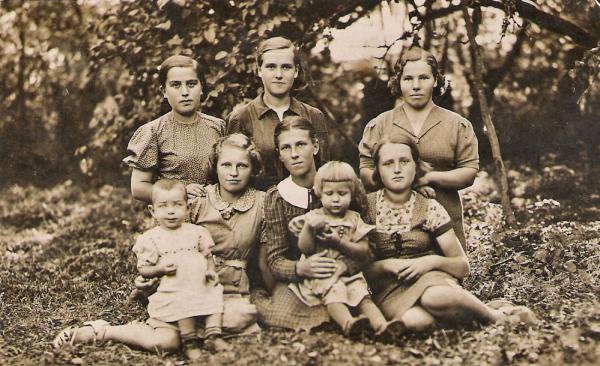
|
| Vishki, about 1940. Upper row, from the left: Liba Dumesh, Tsipa-Lea Dumesh. Lower row, on the right, Doba Dumesh. All the others are unknown. |
In 1935, there were 423 Jewish residents in a total population of 750.
Following the Ribbentrop-Molotove accord, signed by Germany and the USSR in August 1939, the Red Army entered Latvia. In the summer of 1940 a Soviet government was installed. The new regime nationalized businesses and shops, and Jewish public life was liquidated.
On the outbreak of war between Germany and the USSR (June 22, 1941) a number of young Jews escaped to the East. A few days later German forces captured the town. On June 28 the Jews of the town and nearby towns were sent to the Daugavpils ghetto. After several days they were taken to the Pogulianka forest and murdered in the "provincial action" (an operation to liquidate the Jews of country towns).
In July 1944, the Red Army liberated the town.
* this history courtesty of the Association of Latvian and Estonian Jews in Israel
Population of Višķi
| Year | Total Population | Number of Jews | Percent of Jewish Population |
|---|---|---|---|
| 1847 | ? | 194 | ? |
| 1897 | 959 | 668 | 70 |
| 1914 | 1200 | 850 (est.) | 70 (est.) |
| 1920 | 832 | 567 | 68 |
| 1925 | 757 | 510 | 67 |
| 1930 | 770 | 530 | 68 |
| 1935 | 750 | 423 | 56 |
Rabbis of Višķi
For a period of around 90 years, the Pluchinsky/Platsinsky/Ploschinsky family served as Rabbis of Višķi. The first was Rabbi Moshe (Mishel) Platsinsky served as rabbi for more than 40 years. He was known in his youth as the "genius of Suwalki".
SUWALKI, a town of Russian Poland, capital of the government of the same name, situated at the source of the Hancza, a tributary of the Niemen, 65 m. by rail N.W. of Grodno. Pop. 27,165.www.1911encyclopedia.org

|
Rabbi Judah Leib Solomon Platsinsky (1876-ca.1930)
After Moshe's death in 1907, he was succeeded by his son, Rabbi Judah Leib Solomon Platsinsky, born Jan 29, 1876 in Višķi.

|
Rabbi Yankel Meyer Platsinsky (1902-1941)
His son, Yankel Meyer Platsinsky, born on June 6, 1902 in Višķi, studied in Palestine and at the Kovno Yeshiva (Kaunas, Lithuania) where he was ordained. He served as Rabbi in Višķi from 1931 and perished in Višķi in 1941. Petition of the board of the Jewish community to appoint Yankel Meyer Platsinsky as Rabbi in Viš?i 1930. Biographical notes on Rabbi Y.M. Platsinsky 1939


 The pictures
of the Rabbis and synagogue of Višķi are from the wonderful book Latvia
Synagogues and Rabbis 1918-1940. Go to http://www.shamir.lv/ for more info.
The pictures
of the Rabbis and synagogue of Višķi are from the wonderful book Latvia
Synagogues and Rabbis 1918-1940. Go to http://www.shamir.lv/ for more info.
JewishGen
 This page is hosted at no cost to the public by JewishGen, Inc., a non-profit corporation.
If you feel there is a benefit to you in accessing this site, your
JewishGen-erosity
is appreciated.
This page is hosted at no cost to the public by JewishGen, Inc., a non-profit corporation.
If you feel there is a benefit to you in accessing this site, your
JewishGen-erosity
is appreciated.
|
Click the button to show all entries for Višķi
in the JewishGen Latvia Database. (About the JewishGen Latvia Database). |